
Weather by month
Gran Canaria weather: north vs south
The short answer
The south coast is the dry, sunny side of the island: fewer than 10 days of rain a year, the fewest in the Canary Islands, compared with more than 50 on the high ground. North-east trade winds push cloud against the north-facing slopes, so Las Palmas can be grey while Maspalomas is clear. The sea is the same on both sides, to within 0.2°C.
At a glance
The south coast and the north side compared
Rain and air: AEMET and IPMA climate atlas of the Canary Islands, normals 1971-2000. Sea: NOAA satellite record, monthly normal 1991-2020.
| South coast | North side and high ground | |
|---|---|---|
| Days with 1 mm of rain or more | Fewer than 10 a year, the fewest in the Canary Islands | More than 50 a year on the high ground |
| Days with 10 mm or more | Fewer than 3 a year | Over 20 a year in the centre of the island |
| Rain in July | Almost none | Over 5 mm in some parts of the north |
| Summer highs | About 28°C on the coasts that do not face north | About 26°C at sea level |
| Nights of 20°C or more | Over 120 a year on the coast | Under 1 a year on the high ground |
| Climate type | Hot desert | Hot steppe at low and middle altitudes; temperate with a dry summer higher up |
| Sea through the year | 18.9 to 23.3°C off Maspalomas | 18.8 to 23.4°C off Las Canteras |
Why
Why the south stays dry
North-east trade winds push moist air against the mountains. Cloud forms under a temperature inversion on the north-facing slopes, while the south lies in their lee, dry and sunny. This is why Las Palmas and the northern midlands can be grey while Maspalomas is clear. The trade winds give way only for short spells, when polar, desert or equatorial air arrives.
According to the atlas, most rain falls at middle altitudes on the slopes facing north and north-east. The south coast lies in the lee of the mountains, and not a single day a year there brings 30 mm of rain or more.
Where to stay
Pick your side
For the most sun, stay on the south coast, from Playa del Inglés to Puerto de Mogán.
Playa del InglésMaspalomasMelonerasSan AgustínPuerto RicoAmadoresPuerto de Mogán
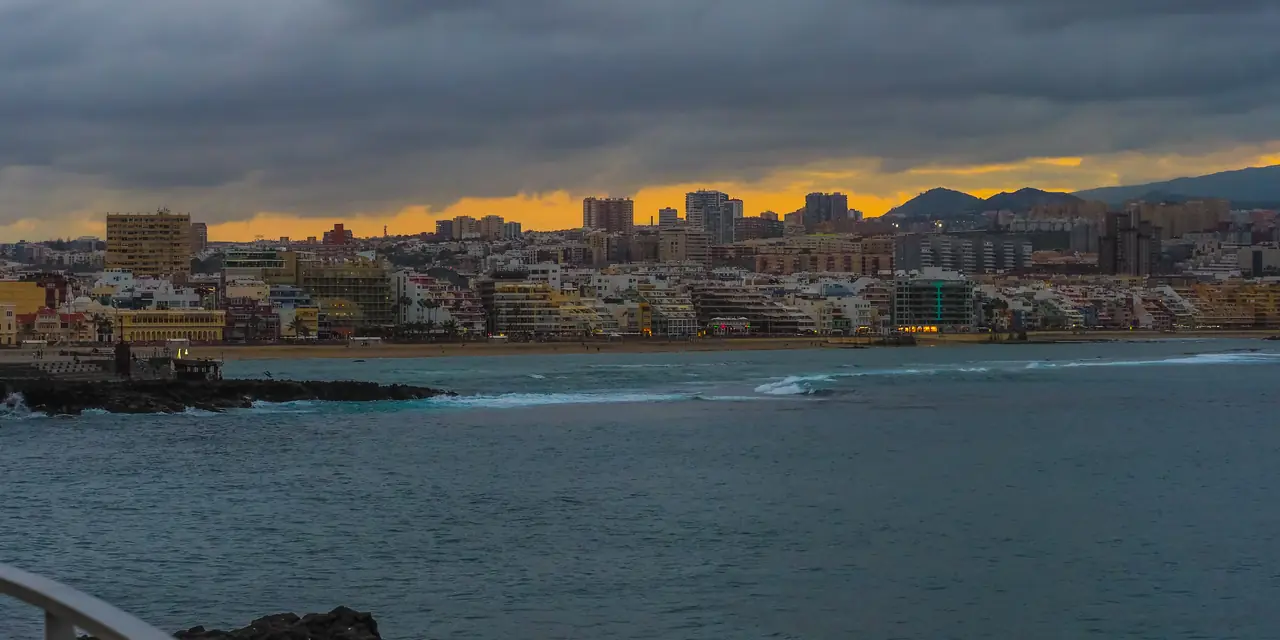
For a city break with Las Canteras beach and the old town, stay in the north and expect more cloud. Teror, in the green northern midlands, gets far more rain than the coast.
The sea
The same sea on both coasts
The water is just as warm in the north. Off Maspalomas and off Las Canteras the monthly normals never differ by more than 0.2°C: about 19°C in February and March, and about 23°C in September and October.
On the day
Check both sides
- If the north is cloudy, the south is often clear, so check the forecast for both sides before a day trip.
- The live webcams show Las Canteras in the north and the beaches of the south right now.
- The summits are far cooler than either coast: take a warm layer to Roque Nublo, at about 1,800 m.
- Calima, Saharan dust carried on hot air, reduces visibility. The Canary Islands government issues pre-alerts for it, so check AEMET on the day.
Book for this trip
Book for this trip
Transfer
Worth booking if you land after the last bus: the final line 66 service is at approx. 20:30 (check on the day).
Hiking
Guided walks and the Roque Nublo trail. Bring an extra layer for the high ground.
Culture
Museums, old towns, markets and festivals. Check which days they close before you go.
Bike and buggy
E-bikes, Segways and buggies, mostly in the south. Read the rules for riders before you book.
Weather by monthBest time to visitWinter sun in Gran CanariaWhere to stay: 14 areas compared
Questions
What people ask about north and south
Is the north of Gran Canaria rainier than the south?
Yes. The AEMET climate atlas counts more than 50 days a year with 1 mm of rain or more on the high ground, compared with fewer than 10 on the south coast, the fewest in the Canary Islands. Most rain falls at middle altitudes, on the slopes facing north and north-east.
Is Las Palmas sunny in winter?
Often, but less reliably than the south. Trade-wind cloud forms on the north side of the mountains, so Las Palmas can be grey while Maspalomas is clear. AEMET publishes no monthly normals for the city itself.
Is the sea warmer in the south?
No. The NOAA satellite record puts the sea off Maspalomas and off Las Canteras within 0.2°C of each other in every month, from about 19°C in February and March to about 23°C in September and October.
Is the south hotter in summer?
A little. The atlas gives average summer highs of about 28°C on coasts that do not face north, compared with about 26°C at sea level elsewhere (1971-2000).